Tuesday, 21 May 2013

sister corita

Alice matkin.
Unit 5 contextual influences folder.
Sister corita.

Sister corita whose real name was corita Kent was born in iowa in November 1918, sister corita was part of the roman catholic order and whils she was here she took creative classes at multiple institutes until she earned her BA in 1941 she then went on to study at university whilst still being a sister in the order she earned her MA in 1951.
 

 She worked mainly with the media of silkscreen serigraphy and other forms of printing and helped to establish it in the world of fine art. Her artwork which has strong messages of love and peace incorporated into it and she was particularly popular during the 1960s and 1970's,she used popular culture such as song lyrics and advertising slogans in her work and this is what seems to have made he work so appealing to the public and the messages behind her work were clear so the pieces that she created actually had meaning and weren't just images pieces of her work such as her piece called for emergency use soft shoulder which was created in 1966.

Whilst working at the immaculate heart college in the art department, sister corita put into place rules that applied to both her students and the staff and these rules were made so that everyone would put there all in and to make mistakes and failing disappear.
 

Rule I
FIND A PLACE YOU TRUST AND THEN TRY TRUSTING IT FOR A WHILE.

Rule 2
GENERAL DUTIES OF A STUDENT:
PULL EVERYTHING OUT OF YOUR TEACHER.
PULL EVERYTHING OUT OF YOUR FELLOW STUDENTS

Rule 3
GENERAL DUTIES OF A TEACHER:
PULL EVERYTHING OUT OF YOUR STUDENTS
Rule 4
CONSIDER EVERYTHING AN EXPERIMENT.

Rule 5
BE SELF DISCIPLINED. THIS MEANS
FINDING SOMEONE WISE OR SMART AND
CHOOSING TO FOLLOW THEM.
TO BE DISCIPLINED IS TO FOLLOW IN A GOOD WAY.
TO BE SELF DISCIPLINED IS TO FOLLOW IN A BETTER WAY.

Rule 6
NOTHING IS A MISTAKE. THERE’S NO WIN AND
NO FAIL. THERE’S ONLY MAKE.

Rule 7
The only rule is work.
IF YOU WORK IT WILL LEAD TO SOMETHING.
IT’S THE PEOPLE WHO DO ALL OF THE WORK ALL THE TIME
WHO EVENTUALLY CATCH ON TO THINGS.

Rule 8
DON’T TRY TO CREATE AND ANALYZE AT THE
SAME TIME. THEY’RE DIFFERENT PROCESSES.

Rule 9
BE HAPPY WHENEVER YOU CAN MANAGE IT.
ENJOY YOURSELF. IT’S LIGHTER THAN YOU
THINK.

Rule 10
"WE’RE BREAKING ALL OF THE RULES. EVEN
OUR OWN RULES. AND HOW DO WE DO THAT
BY LEAVING PLENTY OF ROOM FOR X QUANTITIES." JOHN CAGE
HELPFUL HINTS: ALWAYS BE AROUND. COME OR GO TO EVERY- THING. ALWAYS GO TO CLASSES. READ ANYTHING YOU CAN GET YOUR HANDS ON. LOOK AT MOVIES CAREFULLY, OFTEN. SAVE EVERYTHING IT MIGHT COME IN HANDY LATER. THERE SHOULD BE NEW RULES NEXT WEEK.

Corita Kent’s Rules & Hints for Students and Teachers.
Kent, Corita & Jan Steward, Learning by Heart; Bantam Books, 1992.
 

When I look at sister corita's work I notice that she uses bright colours and different sizes of font and this is used effectively to draw your attention to the key points of her work which is usually a piece of typography for example on her pieces of work that are about Vietnam she will use typography and colour to emphasise the word love.


Tuesday, 5 March 2013

Leonardo Da Vinci

Leonardo Da Vinci was an italian man with many different occupations, such as architecture, painting and sculpting and engineering. Leonardo used architectural techniques to create an ink drawing of a man which was named the Vitruvian man this piece of work shows a man inside a circle inside a square and without looking into the methods behind this piece it is unclear as to why he did this but when you read into it and look at the piece in more depth you realize that it is to do with proportion and measurement, the measured that Da Vinci used are listed below.
  • the length of the outspread arms is equal to the height of a man
  • from the hairline to the bottom of the chin is one-tenth of the height of a man
  • from below the chin to the top of the head is one-eighth of the height of a man
  • from above the chest to the top of the head is one-sixth of the height of a man
  • from above the chest to the hairline is one-seventh of the height of a man.
  • the maximum width of the shoulders is a quarter of the height of a man.
  • from the breasts to the top of the head is a quarter of the height of a man.
  • the distance from the elbow to the tip of the hand is a quarter of the height of a man.
  • the distance from the elbow to the armpit is one-eighth of the height of a man.
  • the length of the hand is one-tenth of the height of a man.
  • the root of the penis is at half the height of a man.
  • the foot is one-seventh of the height of a man.
  • from below the foot to below the knee is a quarter of the height of a man.
  • from below the knee to the root of the penis is a quarter of the height of a man.
  • the distances from the below the chin to the nose and the eyebrows and the hairline are equal to the ears and to one-third of the face.

life drawing - full body

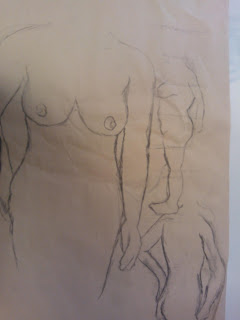
today we had a full body life drawing session, we had to draw from a nude model and this proved to be quite challenging, we started with a drawing a two poses both in which we only had 15 minutes, for our first drawing we were instructed to use pencil and then for the second we were told to use charcoal. The main problem with my first drawings is that parts of the body are out of proportion.
For the second drawing we were shown a method of measuring using our pencils where we measured the height of the head which would become one section and then measure down the body with the same scale to get the correct length of the body and this proved to be very useful and improved the quality of my work. As i became more comfortable with my drawing i began to use the side of my charcoal to add marks to the body as it gave a lighter more shadowed effect.
We were then allowed a short break from our drawing to research into Leonardo Da Vinci's work such as "vitruvian man" which was a way of working out proportion that relates to architecture, after researching into this we returned back to drawing which was still becoming easier the more i did it, this time we were told to do different scaled images and try and fit three to a page, we were given 20 minutes for the first and then 10 minutes for the other two. For the 10 minute ones i focused on key lines that made the figure clear rather than focusing on the details.
for the final three drawings we had to do we were given only 5 minutes for each which i thought would be quite challenging but was actually easy when i put my full focus and attention into it and i was quite pleased with the result i got and learning the pencil proportion skill really helped, as well as looking into Da Vinci's work .
On Tuesday the12th march a week after our first full body session we had another session but this time with an older male model, the same techniques were applied but the male body was much more square and muscular than the females and so it had more tones and lines.
in this session we drew from poses that we had not previously seen and drew certain sections of the body in a larger scale with quite a lot of detail.
The following week we had our third life drawing session, for this we had the male model again, we started out by doing two large 10 minute charcoal drawings just to get us warmed up, i was quite disappointed with my first two drawings as some of the body parts were drawn too thin or fat. 
for our third drawing we were given an hour and a half, we had to draw one image that was the full a2 size and then collage it to create tones on the body for example to show muscles and shadows, i chose to use cartridge paper as my base to draw on and then using a glue stick and watered down PVA glue i layered brown paper, black and white print and tissue paper i also used masking tape for some tones as well and i feel that this was quite effective. I was very pleased with how it was coming together as a piece of work but i failed to work quick enough so was unable to finish it in the set time period.

Tuesday, 26 February 2013

life drawing - jenny saville style

today we had another life drawing class in which we had to focus on drawing the head and face, we were given the task of recreating a face in the style of jenny saville. i selected the image that jenny saville created (shown below) to draw in the style of because i liked the effect that the reds and oranges gave.
to create my own piece first i used a pencil to draw out a rough angular shape of the face and its details. i then used acrylic paints and only my fingers to apply the paint to the page, this was a messy process and proved hard to get the paint in smaller places but was useful as it was easier to blend the colours together.
the face began to look more realistic as i began to use thicker layers of paint and bigger and bolder strokes, i found that using white and also a pale orange were really good for adding highlights to the face.
When it came to going the inside of the eyes i was a bit uncomfortable as i know that the eyes can effect your work dramaticaly if they do not match with your image for example if they were looking the wrong way. I resolved this by using a graphite stick and white paint and was very pleased with the outcome, i then showed the colours that i had used to create my image in swatches underneath my completed image.

jenny saville

I find jenny savilles work to be quite interesting as it is quite abnormal.  I love the way that she creates larger images of the femail body, this to me seems to try to get the message that big is beautiful across and I find this to be what makes her work so unique, she shows that big women are can be used as models too aswell as smaller/slimmer women.


I don’t like the way that in some of her images she will draw parts of men onto the womans body such as penis’s, she may have had some reason behind this but I don’t think that it has any meaning and is a bit disturbing.

I like the way that jenny uses thick lashings of colour in her work and you can tell that she uses either a large brush or even her hand and I think this adds to the quality of her work and the use of unusual colours for parts of the body really has a good impact on her work.

Tuesday, 5 February 2013

what was the holocaust and why did it happen

The Holocaust was the mass murder of six million Jews and millions of other people leading up to and during World War II.
The killings took place in Europe between 1933 and 1945. They were organised by the German Nazi party which was led by Adolf Hitler.

The largest group of victims were Jewish people. Nearly 7 out of every 10 Jews living in Europe were murdered.
Most of the victims were killed because they belonged to certain racial or religious groups which the Nazis wanted to wipe out. This kind of killing is called genocide.

The Nazis also murdered politicians, trade unionists, journalists, teachers and anyone else who spoke out against Hitler.
We will never know exactly how many died but there were many millions of non-Jewish victims, including:

Civilians and soldiers from the Soviet Union
Catholics from Poland
Serbs
Disabled people
Homosexuals
Jehovah's Witnesses
Polish civilians
Roma and Sinti people (Gypsies)
Slavic people

In 1921 Adolf Hitler became leader of the Nazi party. The Nazis were racists and believed that their Aryan race was superior to others.
To them, an Aryan was anyone who was European and not Jewish, Romany or Slavic.
They also thought Germany was a more important country than its neighbours.
In 1934 Hitler became Germany's head of state. He introduced anti-Semitic laws which discriminated against Jewish people living in the areas he controlled.
Some of these laws meant that Jewish children could no longer go to school, keep pets or have a bicycle.
The Nazis believed that Jews were a problem that needed to be removed. The mass killings of the Holocaust were what Hitler called "The Final Solution".
Hitler also wanted to make Germany bigger, so he invaded neighbouring countries and took them over.
Many of the non-German people living on land that he wanted for Germans were also sent to concentration camps.

key dates of world war two.

30th January 1933            Hitler Chancellor of Germany     Adolf Hitler was elected Chancellor of Germany

22nd March 1933              First concentration camp opened             The first concentration camp was opened at Dachau in Germany

1st April 1933     Jewish shops boycotted               Germans were told not to buy from Jewish shops or businesses

1 September 1939      world war 2 begins.

24th November 1933      'Undesirables' sent to camps      Homeless, alcoholic and unemployed people were sent to concentration camps

17th May 1934   Jewish persecution         An order was issued which prohibited Jewish people from having health insurance

15th September 1935     Nuremberg Laws             The Nuremberg Laws were introduced. These laws were designed to take away Jewish rights of citizenship and included orders that:
 Jews are no longer allowed to be German citizens.
Jews cannot marry non-Jews.
Jews cannot have sexual relations with non-Jews.

13th March 1938               Austrian Jews persecuted            Following Anschluss which joined Germany and Austria, Jews in Austria were persecuted and victimised.

8th July 1938      Munich synagogue destroyed    The Jewish synagogue in Munich was destroyed

5th October 1938             Jewish passports stamped with 'J'            The passports of all Austrian and German Jews had to be stamped with a large red letter 'J'

9th November 1938        Kristallnacht       A night of extreme violence.
Approximately 100 Jews were murdered,
20,000 German and Austrian Jews arrested and sent to camps, Hundreds of synagogues burned, and the
Windows of Jewish shops  all over Germany and Austria smashed.
12th November 1938      Jews fined          Jews were made to pay one billion marks for the damage caused by Kristallnacht.

15th November 1938      Jewish children expelled from schools   An order was issued that stated that Jewish children should not be allowed to attend non-Jewish German schools

12th October 1939           Austrian and Czech Jews deported          Jews living in Austria and Czechoslovakia were sent to Poland

23rd November 1939      Yellow Star introduced  Jews in Poland were forced to sew a yellow star onto their clothes so that they could be easily identified.

Early 1940            European Jews persecuted         Jews in German occupied countries were persecuted by the Nazis and many were sent to concentration camps.

20th May 1940   Auschwitz           A new concentration camp, Auschwitz, opened

15th November 1940      Warsaw Ghetto                The Warsaw Ghetto was sealed off. There were around 400,000 Jewish people inside

July 1941              Einsatzgruppen The Einsatzgruppen (killing squads) began rounding up and murdering Jews in Russia. 33,000 Jews are murdered in two days at Babi Yar near Kiev.

31st July 1941     'Final Solution'   Reinhard Heydrich chosen to implement ‘Final Solution’

8th December 1941         First 'Death Camp'           The first 'Death Camp' was opened at Chelmno.

January 1942      Mass-gassing     Mass-gassing of Jews began at Auschwitz-Birkenau

Summer 1942    European Jews gassed  Jews from all over occupied Europe were sent to 'Death Camps'

29th January 1943            Gypsies sent to camps   An order was issued for gypsies to be sent to concentration camps.

19th April - 16th May 1943            Warsaw Ghetto Uprising              An order was issued to empty the Warsaw Ghetto and deport the inmates to Treblinka. Following the deportation of some Warsaw Jews, news leaked back to those remaining in the Ghetto of mass killings.
A group of about 750 mainly young people decided that they had nothing to lose by resisting deportation. Using weapons smuggled into the Ghetto they fired on German troops who tried to round up inmates for deportation.
They held out for nearly a month before they were taken by the Nazis and shot or sent to death camps.

Late 1943             'Death Camps' closed     With the Russians advancing from the East, many 'Death Camps' were closed and evidence destroyed.

14th May - 8th July 1944                Hungarian Jews sent to Auschwitz           440,000 Hungarian Jews were transported to Auschwitz

30th October 1944           Auschwitz           The gas chambers at Auschwitz were used for the last time

27th January 1945            'Death Marches'               Many remaining camps were closed and evidence of their existence destroyed. Those who had survived the camps so far were taken on forced 'Death Marches'.

30th April 1945  Hitler committed suicide               Faced with impending defeat, Hitler committed suicide

7th May 1945     German surrender          Germany surrendered and the war in Europe was over

2 September 1945                  world war 2 ends  (6 years, 1 day)


20th November 1945      Nuremberg war trial began         Surviving Nazi leaders were put on trial at Nuremberg